
Discover the Intersection of
Collections and AI
Built to perform across the customer journey.
“Science is the search for truth, that is, the effort to understand the world: it involves the rejection of bias, of dogma, of revelation, but not the rejection of morality.”
– Linus Pauling
Artificial Intelligence has transformed industries worldwide, reshaping how businesses operate, governments function, and individuals interact with technology. From healthcare and finance to retail and law enforcement, AI is driving efficiency, innovation, and decision-making at an unprecedented scale. However, as AI continues to integrate into society, its growing influence has also brought ethical concerns to the forefront, particularly around the issue of bias in AI.
AI, at its core, is designed to replicate or simulate human intelligence, but the data it processes is often tainted by human prejudices, leading to skewed or biased outcomes. This raises ethical questions about the role AI should play in shaping critical aspects of life, including employment, justice, healthcare, and security. The ethical issues in AI are not merely theoretical—they have tangible consequences that affect real people and institutions.
In this blog post, we will explore the origins of bias in AI, its far-reaching consequences, and strategies for mitigating these biases. We will also dive into the ethical boundaries of AI usage, current efforts to address bias, and the evolving landscape of AI ethics.
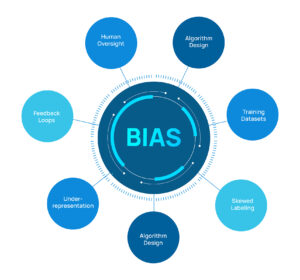
Bias in AI often originates from the data that is fed into machine learning models. AI systems are only as good as the data they are trained on, and if that data is biased, the AI system will reflect and potentially amplify that bias. Bias can be embedded in AI through several ways:
Training Datasets: AI models learn from data, but when that data is incomplete, skewed, or not representative of the real world, the model will generate biased predictions. For example, if an AI system for facial recognition is trained predominantly on lighter-skinned faces, it will struggle to recognize individuals with darker skin tones, leading to racial bias.
Algorithm Design: Bias can also occur at the algorithmic level. Algorithms may prioritize certain attributes over others, consciously or unconsciously reflecting the biases of the developers. For instance, an AI-driven hiring tool might favor candidates based on criteria that historically correlate with a specific gender or ethnicity, reinforcing discrimination.
Human Oversight: Human biases can unintentionally seep into AI systems during the design and development phases. Developers’ own implicit biases, such as unconscious gender or racial preferences, can shape how they select data, design models, or choose evaluation metrics.
The technical aspects of bias in AI involve complex interactions between data and algorithms. Some of the key challenges include:
Feedback Loops: AI models are often designed to continuously learn and update based on new data. However, if initial predictions are biased, those biases can become reinforced over time, creating a feedback loop of discrimination.
Underrepresentation: AI systems may be exposed to biased data because certain populations are underrepresented in the training dataset. For example, in medical research, women and minorities are often underrepresented, leading to AI models that may be less effective for these groups.
Skewed Labeling: Data labeling—where human workers tag datasets to train AI models—can introduce bias. If labelers’ biases influence how data is tagged (e.g., tagging images of certain professions as male-dominated), the AI model will reflect those societal biases.
Despite advancements in AI, bias remains a pervasive issue due to a combination of historical, cultural, and systemic factors. Together, these factors contribute to the persistence of bias in AI, underscoring the importance of diverse teams, unbiased data, and proactive efforts to address systemic inequities.
The broader impact of these biases can lead to a loss of public trust in AI systems, eroding confidence in their fairness and reliability. Biased AI systems may also violate anti-discrimination laws or privacy regulations, posing a risk of legal consequences.
Despite these challenges, several strategies exist to mitigate bias in AI:

AI has an incredible capacity to drive innovation, efficiency, and growth across industries, but this power also brings significant responsibility. The ethics in AI conversation is crucial because AI can have far-reaching effects on privacy, security, and individual autonomy. Deciding where to draw the line in using AI comes down to determining the ethical, moral, and societal limits that prevent harm.
For example, the use of AI in surveillance is highly debated. AI-enabled facial recognition systems are becoming more common in public spaces, used by both private companies and governments. While these systems can enhance security, they also pose serious privacy concerns. Is it acceptable for governments to track citizens’ movements without their consent? What are the risks of such technology being abused by authoritarian regimes, leading to mass surveillance and control?
Facial recognition also introduces bias. Many systems struggle to accurately identify people from certain demographic groups, particularly racial minorities. This has led to misidentification, wrongful arrests, and increased scrutiny on specific communities, raising the question: where do we draw the line between security and the potential for racial discrimination?
These dilemmas—choosing between efficiency and the risks of ethical compromises—are common challenges for organizations looking to adopt AI. The concerns are valid, but when AI is implemented cautiously, with the guidance of experienced vendors and industry-specific expertise, businesses can achieve greater efficiency while upholding ethical standards.
As AI continues to evolve, the challenge lies in balancing the immense potential of AI innovation with its ethical responsibilities. Developers must ensure that their systems not only meet technical standards but also align with societal values like privacy, fairness, and human rights.
For example, AI systems used in healthcare can assist in diagnosing diseases more accurately and efficiently. However, biases embedded in AI algorithms may lead to disparities in treatment for different racial, gender, or socioeconomic groups. Balancing the life-saving potential of AI with ensuring equitable access to care for all patients is a critical ethical consideration.
Another ethically contentious area is AI in hiring. Many companies have turned to AI-driven tools to screen resumes and identify the most suitable candidates. While this improves efficiency, the technology can perpetuate biases, as seen in some cases where AI algorithms favored male candidates over female ones based on biased historical data. Ensuring that AI doesn’t unfairly disadvantage certain groups requires constant vigilance, diversity in datasets, and the development of bias-free algorithms.
Bias in AI remains a significant and widespread issue across various sectors, from healthcare to law enforcement to finance. Despite advances in AI, recent research indicates that these systems continue to reflect and amplify the biases present in their training data. This is particularly troubling in critical areas where biased outcomes can have severe consequences for individuals and groups.
For instance, in healthcare, several studies have shown that AI systems used to predict medical conditions or prioritize care tend to underperform for minority groups. A well-known case involved an algorithm used in U.S. hospitals to determine which patients would receive extra medical attention. The system was found to be biased against Black patients, often underestimating the severity of their conditions compared to white patients with the same symptoms.
Similarly, AI in hiring processes has faced scrutiny due to its potential to perpetuate gender and racial biases. For example, a hiring algorithm used by a major tech company was found to be biased against women because it was trained on resumes submitted primarily by men over a decade. This bias affected the algorithm’s ability to evaluate female candidates fairly.
In law enforcement, predictive policing algorithms have drawn attention for disproportionately targeting minority communities. These systems often rely on historical crime data, which may reflect biased policing practices. As a result, the AI tools may direct more police resources toward communities that have been over-policed in the past, reinforcing cycles of discrimination.
Despite these challenges, significant efforts are being made to reduce bias in AI. Both private companies and government organizations are increasingly focused on addressing fairness and accountability in AI systems. Some emerging trends include:
Governments are also taking steps to regulate AI, with initiatives like the AI Act in the European Union leading the way in ensuring fairness and accountability. The act would impose stricter requirements on AI systems used in sensitive areas like hiring, healthcare, and law enforcement, ensuring that they meet ethical standards.
Addressing bias in AI is about more than just creating effective technology—it’s about ensuring that these systems are just, fair, and equitable. Developers must take into account ethical considerations in every phase of AI development, from data collection to deployment. Ethical frameworks, such as those advocating for fairness, accountability, and transparency, are increasingly being adopted by organizations and governments alike.
Collaboration between AI developers, ethicists, and policymakers is crucial for building ethical AI systems. These partnerships will help ensure that AI technologies align with societal values and work for the benefit of all, not just a privileged few.
Are you interested in learning more about how Conversational AI can benefit your business? Book a demo with one of our experts.
Built to perform across the customer journey.


 What to Look for When Purchasing a Conversational AI Solution for Collectio...