

Discover the Intersection of
Collections and AI
Built to perform across the customer journey.
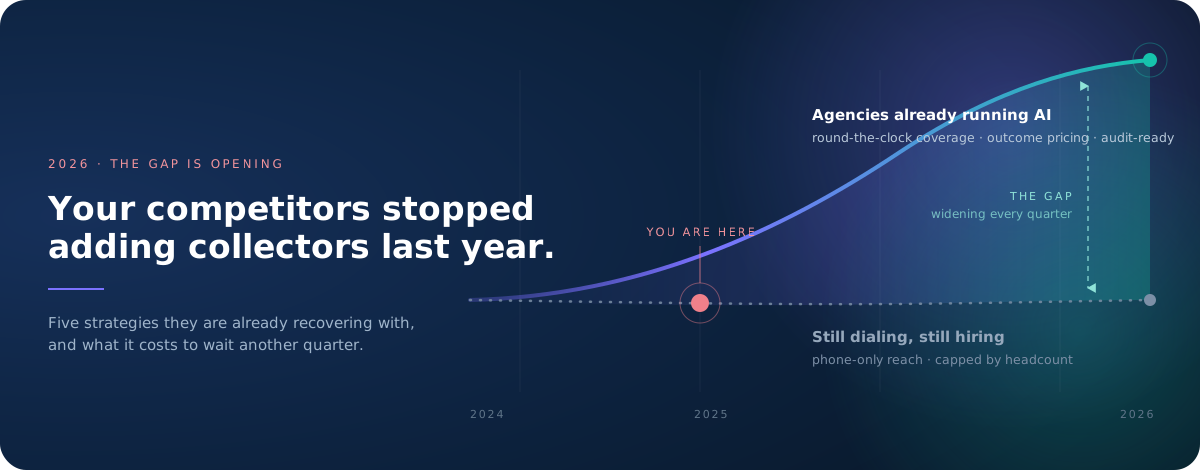
Ask ten collection agency leaders what changed this year, and you’ll hear the same story: volumes are climbing, headcount is flat or frozen, phone contact rates keep sliding, and clients are asking harder compliance questions than ever. None of that is just sentiment: consumer credit card balances have been sliding into delinquency at an elevated, rising pace, according to Federal Reserve researchers. AI for debt collections has stopped being a “someday” line item and has become a board-level mandate. But most agencies are still stuck on the same question: where do we actually start?
This guide skips the hype and gets practical. Drawing on what agency operators, law firms, and creditors are raising in conversations right now, it lays out five AI debt collection strategies agencies are deploying today, and what to watch for before you commit. It’s written for agency owners, collections managers, and operations leaders trying to turn debt collection automation from a buzzword into recovered dollars, without adding a single collector.
The pressure is coming from the top. Executive teams are handing down AI adoption as a strategic imperative, often at organizations under hiring freezes where the only way to handle rising delinquency volume is to scale without growing the team. As one finance-platform leader put it bluntly, “AI for the organization is kind of a mandate. We’re in a hiring freeze, and we can’t hire agents as volumes increase.”
The numbers bear that out. TransUnion’s 2025 Debt Collection Industry Report puts AI or machine-learning use among collection firms at 93%, with only 7% reporting no plans to adopt it. Manny Plasencia, senior director of third-party collections at TransUnion, framed it plainly in 2025: “AI is no longer an option, it’s a necessity for agencies that want to stay ahead.”
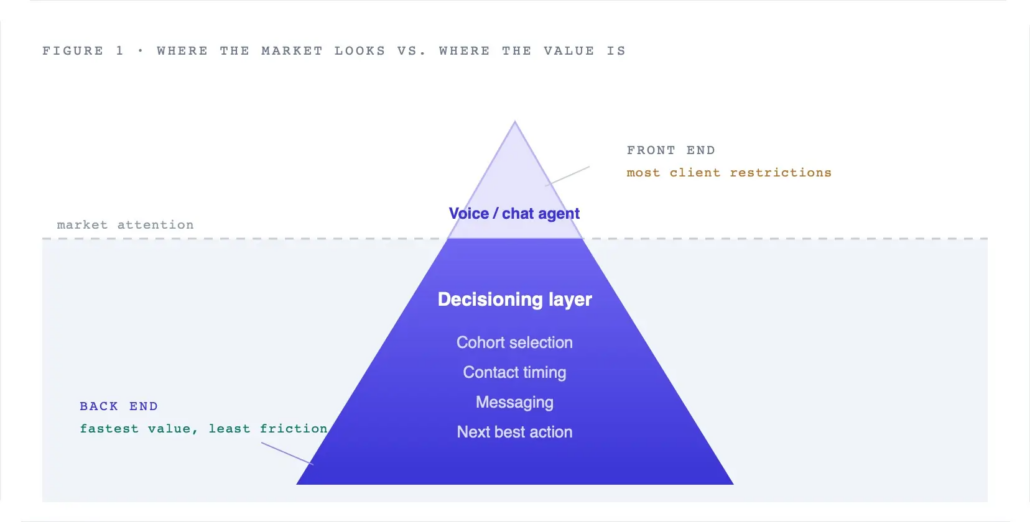
That urgency has also raised the bar. Sophisticated agencies no longer want “a voicebot that dials.” They want collections AI that decides who to contact, when, on which channel, and with what message: strategy-first automation rather than a faster dialer, all inside airtight compliance guardrails.
There’s a deeper shift worth calling out. Most of the market is fixated on AI in the front end: the voice or chat agent that talks to the consumer. The bigger, quieter opportunity is AI in the collection strategy itself, the decisioning layer that decides how a whole portfolio gets worked, and it’s the part almost nobody is talking about. It’s also where AI is easiest to adopt, because strategy-side intelligence optimizing cohorts, timing, and messaging behind the scenes rarely trips the compliance red flags a consumer-facing bot can. In short, the back end is where agencies get value fastest, with the least friction.
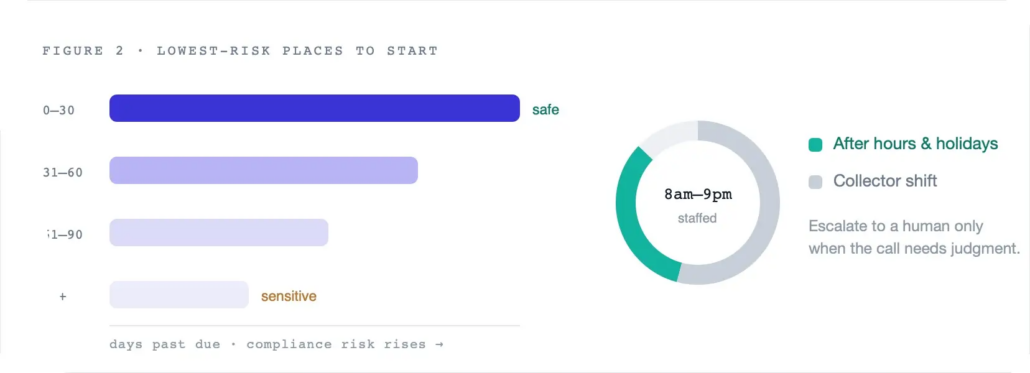
Repetitive, low-complexity outreach like first-touch reminders, payment nudges, and endless follow-ups occupies a massive part of a collector’s day. Since this work requires no human judgment, it is the ideal entry point for AI outbound calling.
Intelligent voice assistants can hold natural parallel conversations, confirm identity, explain balances, and escalate to humans only when necessary. Being dramatically cheaper than collectors, AI allows agencies to scale inventory coverage without growing payroll. As one agency leader put it, “An AI agent is going to be cheaper than a collector, and if it works, the sky’s the limit.” The resulting recovery lift stems simply from executing contact attempts that otherwise would never happen.
The pain is sharpest for small teams. One five-person legal collections group was working roughly 500 delinquent accounts a month by hand, exactly the repetitive follow-up load AI is built to absorb so the humans can focus on the accounts that need them.
Agencies should start where AI is easiest to justify and carries the least compliance risk, such as 0-30 days past-due segments, after-hours coverage, and holiday weekends. Proving the model on these low-stakes scenarios safely builds confidence before extending it to sensitive, later-stage accounts.
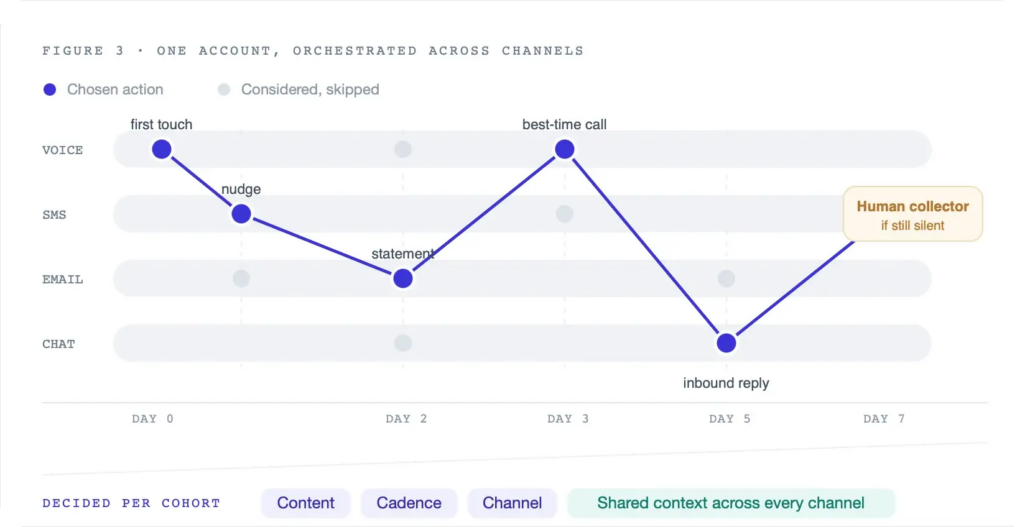
Reaching consumers requires an omnichannel approach, as single-channel, phone-only strategies fail when unknown numbers are ignored. Leading agencies coordinate voice, SMS, email, and live chat, letting data determine the best channel for outreach.The shift is industry-wide: TransUnion’s 2025 report shows the vast majority of collection organizations now offer self-service options, as consumers, especially younger ones, move away from answering the phone toward digital channels. As the collections lead at one large service provider put it, “this customer’s born in 1992 versus this one born in 1952. Which one should I text versus call? Right now, we treat them as though they’re the same.”
Genuine collection intelligence uses debt collection management software to analyze account signals like debt type, age, and digital interactions. Instead of rigid sequences, it dynamically determines the next best action, such as optimal call timing or routing unresponsive accounts to human collectors. As the collections lead at one B2B billing company put it, “if it’s known that this customer is better to be called at 3 p.m., not emailed, and we know that from data, then we need to be doing that.”
This strategy optimizes the three C’s: content, cadence, and channel. Successful operations define these explicitly per cohort and adjust the consumer journey in-flight, capturing significant recovery upside through back-end intelligence. Cadence is a good example, as one collections leader put it: “if a customer pays on the third of every single month, why am I gonna bother them on the first, the second, and the third? Why not wait until the fourth and say, we noticed you pay each month on the third and we haven’t seen it, just making sure everything’s okay.”
Crucially, channels must share context to ensure continuity, turning separate interactions into a cohesive conversation that delivers enhanced CX. This unified layer flexes between B2C needs like voice AI and SMS, and B2B requirements like email automation and invoice retrieval.
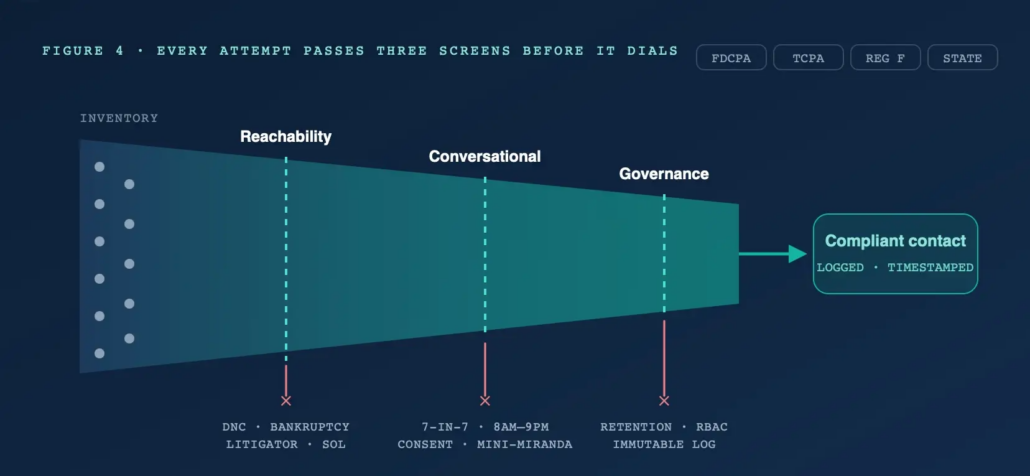
For agencies and debt buying law firms, compliance isn’t a feature; it’s the license to operate. Every automated conversation runs straight through the FDCPA, Regulation F, the TCPA, and a growing patchwork of state rules. It’s also the single biggest thing slowing AI adoption: many agencies report that their largest clients contractually restrict or outright prohibit conversational AI. The exposure is quantifiable: debt collection complaints to the CFPB jumped to about 387,400 in 2025, an 86% increase over the prior year, and attempts to collect debts consumers say they don’t owe remained the top issue, exactly the kind of dispute a complete, auditable record is built to resolve.
That’s precisely why compliance-first design is a use case in its own right. Purpose-built AI enforces the rules more consistently than a human under pressure ever could: contact-frequency limits (including Reg F caps), required disclosures like the Mini-Miranda delivered the same way every time, consent captured and honored, and every interaction logged in an auditable record. The value of AI voice agents scripting highly regulated outbound collections is that they don’t improvise, don’t skip a disclosure on call 400, and produce the exact audit trail that proves FDCPA compliance to clients and examiners.
One related driver: data sovereignty. A growing number of clients, particularly those with state contracts, restrict offshore human agents entirely, pushing demand toward onshore and AI-only collection models. So a compliant AI layer isn’t just defensive; it can unlock client segments that were previously off-limits for an AI debt collection agency. When you can demonstrate how collections compliance is enforced and prove it afterward, compliance flips from your biggest barrier into your biggest opportunity.
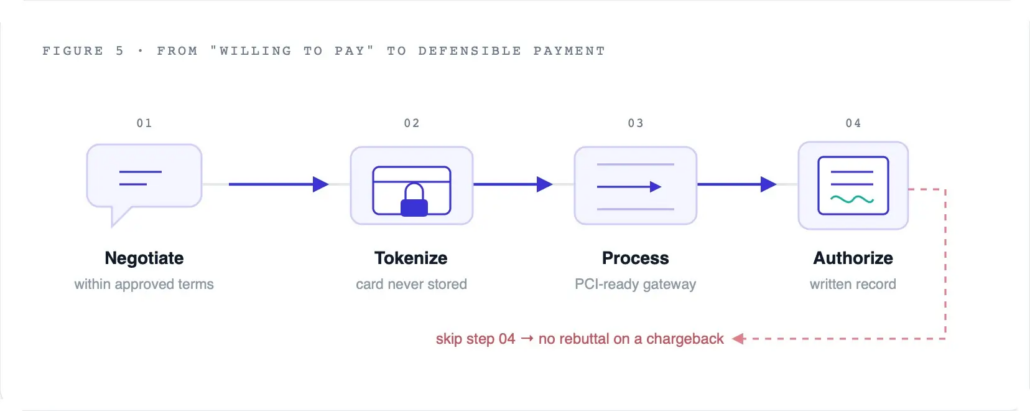
Reaching a willing payer and then making them wait to pay is where recovery leaks quietly. The highest-value automated conversation resolves the account in the moment: negotiating a plan and capturing payment or authorization on the same call, while intent is high. Clients increasingly expect AI agents to close this loop rather than schedule a callback.
The catch is that real-time payment is where compliance gets technical. PCI requirements mean card data must flow through tokenized channels so raw numbers never live in the agency’s environment. There’s also a documentation trap: payments often need authorization in a specific written form, because when a consumer later disputes a charge, an agency without it can’t rebut the chargeback. As one operations leader put it, without written authorization, “we can’t rebut.”
So the use case isn’t just “let the bot take a card.” It’s an automated debt collection software flow that negotiates within approved parameters, processes payment through a PCI-ready gateway, and captures the authorization record needed to defend against chargebacks. Done right, it shortens the distance between “willing to pay” and “paid,” the shortest path to a higher recovery rate.
Outbound gets the attention, but inbound is where a lot of resolution happens: consumers calling back after a text, asking about a balance, or ready to set up a plan at 9 p.m. when no collector is staffed. AI inbound and outbound calling together means those calls get answered, authenticated, and often resolved around the clock, not dropped to voicemail. As one large debt-buying firm framed the goal, the aim is to “efficiently validate customers and connect them to collectors without losing them in the transfer.”
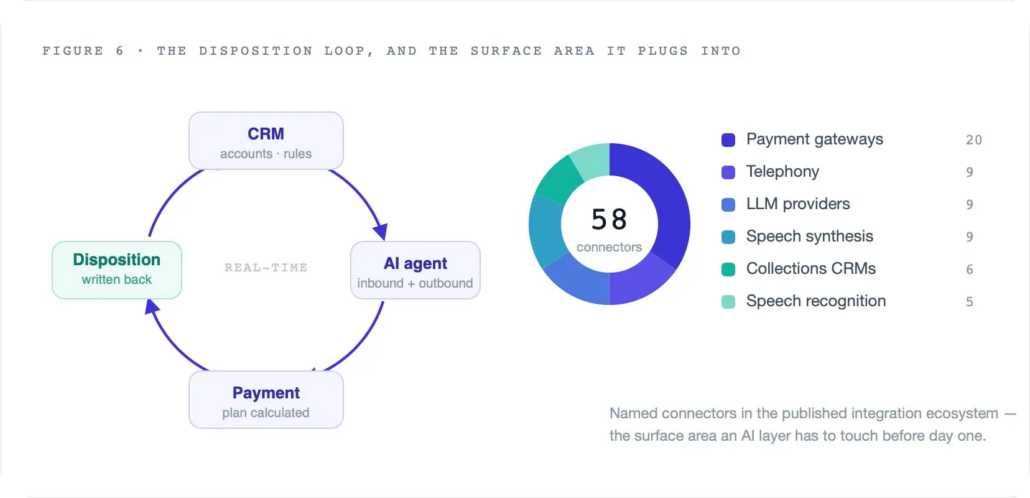
The bigger, quieter challenge is integration, and virtually every agency raises it as the number-one technical hurdle. The best debt collection software is useless if it can’t connect to your systems. Legacy CRMs with no APIs, batch-file versus real-time data sync, calculating payment plans correctly, and writing dispositions back to drive the next contact: these integration capabilities are the silent killer of AI adoption when they’re missing. One agency described early failures bluntly: the system “wasn’t even calculating payment plans correctly,” so payments couldn’t be set up.
The takeaway is to treat integration as a first-class evaluation criterion, not an afterthought. Ask any AI for collections vendor how it connects to your CRM and dialer, how dispositions flow back, and how it handles legacy systems without clean APIs. A platform that can handle all forms of debt collection but can’t write a result code back into your system of record will strand your data, and your strategy, on day one.
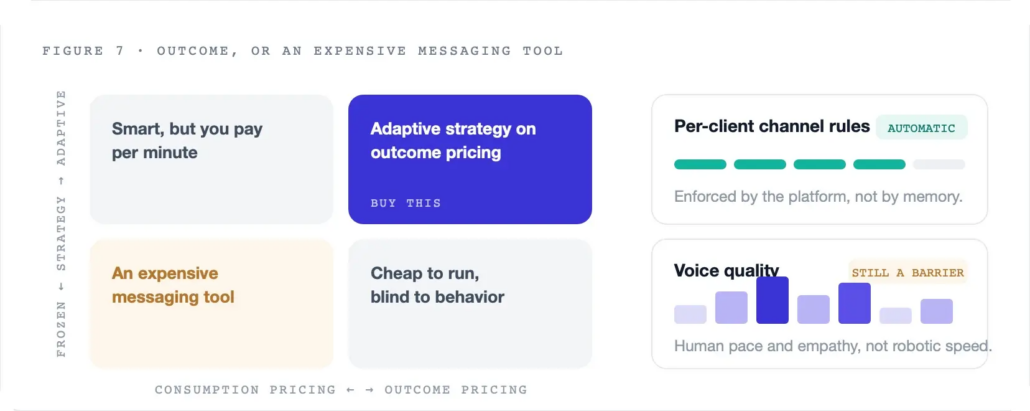
Don’t try to boil the ocean. The lowest-risk entry point is usually the repetitive follow-up work in use case one, or a segment you’re barely touching: prove the model on a slice, then expand. From there,when comparing debt recovery software, a few questions separate a real outcome from an expensive messaging tool. Does the vendor charge for consumption (per minute or message) or for outcomes? Outcome-based, contingency-style pricing is fast becoming the norm because it aligns incentives and de-risks the pilot. As one small-business owner put it, “one collection agency gets 30%. I don’t mind paying that if we can collect.” Does the strategy adapt from real-time behavior at the account level, or run a frozen campaign? Are per-client channel restrictions enforced automatically? And does the voice quality hold up? Skepticism about “robotic,” too-fast AI voices is still a real barrier, especially with high-value B2B customers, so human-sounding, empathetic conversation is worth insisting on.
The forces reshaping collections aren’t going to reverse: collapsing phone contact, rising compliance exposure, and flat headcount against growing delinquency. The agencies pulling ahead aren’t the ones that bought a voicebot; their effective debt collection strategies put AI where it does the most work, from scaling outreach and orchestrating the right channel to enforcing compliance and closing payments. The most overlooked recovery in your operation isn’t a new technology; it’s the volume of contact, follow-through, and after-hours resolution your current team can’t reach.
So start small: pick one of these use cases, run it on a real segment of your inventory under your own rules, and see what an intelligent, compliance-first collection strategy actually returns. The right AI partner won’t ask you to take that on faith; they’ll prove it on your own data first.
It can be, and done properly, it’s often more consistently compliant than manual collections. A purpose-built platform enforces the rules automatically: contact-frequency limits (including Reg F), required disclosures like the Mini-Miranda, consent tracking, and opt-out handling, applied identically every time with a full audit trail. Choose an AI collection agency platform built for regulated collections, not a general-purpose bot.
Yes, but the strategies differ, and the right platform flexes to each. B2C debt collection leans on voice AI and SMS for high-volume consumer accounts, while B2B collections software workflows revolve around email automation, invoice retrieval, and dispute routing. Confirm a platform can handle all forms of debt collection your portfolio includes rather than optimizing for one motion.
Increasingly, yes, but voice quality is still the differentiator. Concerns about robotic tone, latency, and speaking too fast are real adoption barriers, especially with high-value customers.As one collections executive put it, “there’s still a difference between human and AI interactions, but as long as customers don’t resist, it shouldn’t be a problem,” particularly across segments with different engagement preferences. The AI worth paying for sounds human, handles hardship conversations with empathy, and negotiates naturally. Many agencies start with lower-risk segments and expand as it proves out.
Integration is the most common technical hurdle agencies face, so treat it as a primary selection criterion. Ask how the platform connects to your CRM, dialer, and payment systems; how it syncs data; and how it writes dispositions back. Legacy systems without clean APIs are a known blocker, so get specifics before signing.
Start narrow. Pick one use case (usually high-volume outbound follow-ups or a segment you’re barely working on), set your channel rules and compliance guardrails, and run it for a defined period. Favor outcome-based (contingency) pricing so you pay only on what’s collected, and expand once the numbers prove out.
Ready to see what AI recovers on your inventory? The strongest evaluations start with a sample of your own files, your own channel rules, and a clear read on incremental recovery, not a generic demo.
Book a Demo to transform your collections today.
Built to perform across the customer journey.

