

Discover the Intersection of
Collections and AI
Built to perform across the customer journey.
Collections for law firms have quietly become one of the hardest problems in legal operations. Firms sit on growing inventories of placed accounts, judgments, and pre-litigation files while phone contact rates fall and clients tighten what collectors may do. Dialing harder, sending more letters, and hiring more collectors no longer pencils out. This guide covers what collections for law firms looks like in 2026, where the money leaks, and how AI for debt collections helps firms recover more from the same inventory without growing their teams.
It’s written for collections managers, managing attorneys, and operations leaders at debt collection law firms, creditor’s rights practices, debt buying law firms, and firms that take third-party placements, and it reflects how collections actually run today, including the parts most vendor pages skip.
A collection agency owns its workflow end to end. A law firm usually does not, and that single structural fact shapes how collections for law firms have to work.
Most firms work third-party placements: a creditor or debt buyer hands over accounts, and the firm earns a contingency fee, often 15% to 35% of what it recovers, on top of the client’s own cut. When a firm nets only 15% to 20% of a collected dollar, the cost of working low-balance accounts can quickly exceed what the account is worth.

The cost-of-filing problem is the clearest example. If filing a lawsuit costs more than the debt itself, the math doesn’t add up, and firms accumulate large segments of inventory that are technically active but economically unworkable through litigation.
Firms also face client-controlled channels. The creditor, not the firm, often dictates what outreach is permitted; large banks in particular may prohibit AI voice entirely or restrict which channels reach their consumers. Any approach has to switch channels on and off per client and stay inside those guardrails automatically.
Finally, firms carry dormant inventory almost no one is actively collecting: post-judgment files waiting on a refinance, home sale, or lien payoff, run through waterfall skip-trace cycles with some outbound dialing layered on. As most firms admit, hoping to reach someone by phone is now close to the least effective recovery method available.
Before fixing collections for law firms, it helps to name where recovery leaks. Across firms of very different sizes, the same five gaps recur.
Phone-heavy operations with collapsing contact rates. People no longer answer unknown numbers. When the primary channel stops connecting, recovery rates fall no matter how hard collectors work.
Static campaigns that never adapt. Automated collections software often runs a fixed email series for a month or two while the strategy inside never changes. Real debtor behavior, who opened, clicked, or abandoned a payment, never feeds back into what happens next.
Unworkable and dormant segments left fallow. Low-balance accounts, files where filing costs exceed the debt, and aged post-judgment inventory get parked. Skip-tracing runs, but no intelligent strategy is applied. This is often the single largest pool of recoverable-but-ignored value in the firm.
Headcount that cannot scale with inventory. It’s common to see a firm managing hundreds of thousands of files with a few dozen collectors, sometimes an entire product line run by one person. The work simply can’t be done at the volume the inventory demands.
Disconnected channels and lost context. Email lives in one system, calls in another, case management in a third. When a debtor says something on a call, the email channel never knows; when they reply to an email, the next call starts from zero, which is especially costly in litigation, where a complete record of debtor communication matters enormously.
The meaningful shift in debt collection automation is moving from automating individual tasks to owning the recovery outcome. These aren’t the same thing, and the difference is where firms gain or lose money.
Most AI vendors sell automated debt collection software that automates a channel and charges for consumption, a per-message or per-minute fee regardless of whether anything is recovered. That can lower cost per contact, but it doesn’t move the bottom line; you can buy the best voicebot or intelligent voice assistant and still see flat recovery if the strategy never improves.
The alternative treats AI for collections as a recovery outcome, not messaging volume. A partner takes a segment of inventory, continuously refines the strategy, and charges contingency, a percentage only when a dollar is collected. For dormant and unworkable segments, this aligns incentives cleanly: the firm pays nothing unless recovery happens on files it wasn’t effectively working anyway.
Underneath sits a collection intelligence engine: a decision layer that ingests a portfolio, reads each account’s signals (debt type, age, demographics, prior interactions, email opens, payment-link clicks), and chooses the next best action per debtor. Does this person respond to a Monday call or a Wednesday email? Have they opened a payment email three times without paying, signaling a human collector should call to find the blocker? The strategy adapts in real time instead of following a frozen campaign.
The execution layer runs as a coordinated system, orchestrating specialized AI agents for scoring and tracing, strategy, compliance auditing, the collector conversations, and continuous coaching, with a human escalation point always available. Some conversations need judgment only a person can bring, and the system routes those to people rather than forcing a bot through them.
Crucially, the channels talk to each other. If a debtor asked a question by email, the follow-up voice call carries that context; if a collector noted someone lost their job, the next call opens from there rather than cold. That continuity turns a series of nudges into a real conversation, and resolution usually takes multiple coordinated touches in the debtor’s preferred medium.
The clearest way to understand the model is to see a real firm use it. Pollack & Rosen, P.A. works third-party placements and, over roughly two years, has placed about 60,000 accounts with Skit.ai. Around 95% is retail consumer debt, essentially B2C debt collection: debt-buyer credit card paper, student loans, and a sizable eBay portfolio.
The problem is one almost every firm recognizes. Before AI, its collections were limited to a small in-house team, so most energy went to litigation. Since filing suit on every account isn’t wise, the firm keeps a top-of-funnel filter: clear litigation cases stay in-house, and the remainder, which would otherwise languish, become candidates for digital collection.
Pollack & Rosen, P.A. were hesitant that they wouldn’t pay for AI unless the AI made money. That requirement shaped everything, and it’s why contingency became the model: Skit.ai earns only when it collects, so the firm carries no platform cost and no risk on accounts it wasn’t working on anyway. The clients agree, preferring to recover sooner through digital outreach than drag accounts through a slower, costlier legal process.
The work runs first-party, under the firm’s name: every conversation presents as the firm’s, and all messaging is firm-approved before it goes out. Skit.ai leads with SMS and email, using human collectors and voice AI as backup and capturing real-time consent; an email might ask whether the consumer wants a callback, and only that consent opens a voice AI conversation. Behind the scenes, collection experts and AI engineers work the accounts continuously, analyzing connectivity, deliverability, and regional open rates to find the right time and channel for each consumer. That constant optimization is the source of the lift.
The takeaway isn’t “outsource everything.” It’s that the inventory not worth litigating, the accounts your filter sets aside, is exactly where a contingency-based, first-party, compliance-controlled AI partner can recover money you’d otherwise never see, under your name and approved messaging, without adding a single collector.
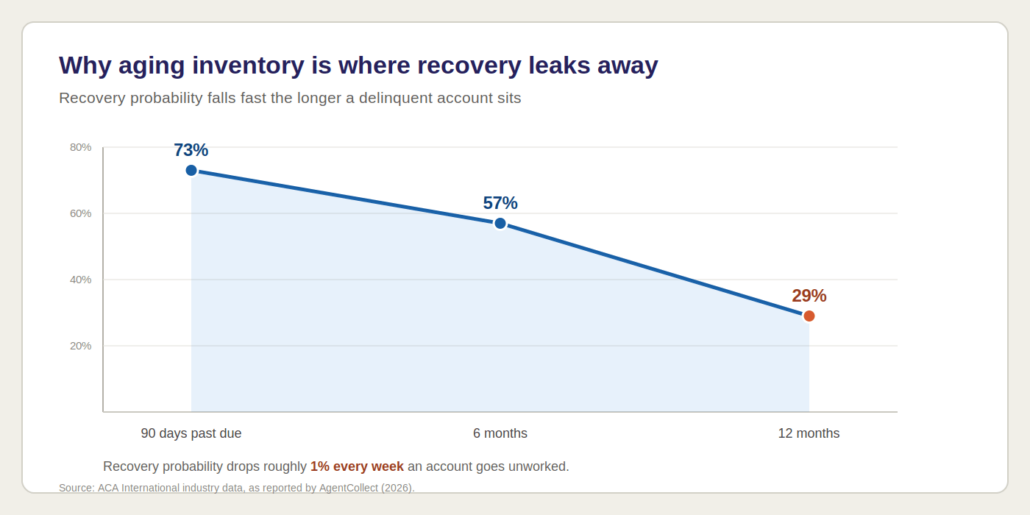
The most actionable opportunity for most firms isn’t the active litigation pipeline; it’s the inventory they’ve effectively given up on.
A firm has hundreds of thousands of files, many dormant: post-judgment accounts skip-traced periodically, low-balance files where litigation isn’t economical, and aged accounts that may become collectible when a debtor refinances or sells a home. Today these get passive treatment and occasional dialing, the least effective method available.
The play is to carve off a segment and run it through an intelligent, multichannel, contingency-based process as an extension of the in-house team. The firm sets the rules: allowed channels (respecting client restrictions), strategy, and what’s off-limits. The partner owns recovery on that segment and earns only on what it collects, typically holding files around 90 days, long enough to see movement.
One nuance for post-judgment files: not all incoming money comes from active effort, a title payoff on a judgment lien may have arrived anyway. Honest measurement separates recovery the process actually generated from payments that would have come regardless, which is exactly why a contingency model, paid on genuine incremental recovery, fits this segment.
Some firms already run this successfully. A firm that began with simple email automation can grow into full first-party subservicing on inventory not worth its internal bandwidth, with the partner running strategy, digital channels, and human escalation on contingency for years.
For law firms, collections compliance isn’t a feature; it’s the license to operate. Collections run straight through the FDCPA, Regulation F, the TCPA, and expanding state rules. Complaints about aggressive tactics have risen sharply, plaintiff’s-bar firms use call transcripts as evidence, and state attorneys general have brought major actions. A single mishandled communication surfacing in discovery can cascade into a class action.
Any AI-driven approach therefore has to bake compliance into the workflow: automatic contact-frequency limits, consistent required disclosures, per-client channel restrictions, and a complete, auditable record. The same trail that protects the firm in litigation also proves compliance to examiners. For firms across jurisdictions, locality-aware compliance is a core selection criterion, not a nice-to-have.
The takeaway: treat a tool’s compliance architecture and audit trail as table stakes. If it can’t show how it enforces the rules and prove it afterward, it’s a liability dressed as efficiency.
If your firm is weighing how to modernize collections and choose the best debt collection software, these questions separate a real outcome from an expensive messaging tool.
First, does the vendor charge for consumption or outcomes? For debt recovery software, consumption pricing (per minute or message) can fit active, high-contact segments you already work well; for dormant and unworkable inventory, contingency pricing aligns better, since you pay only on incremental recovery.
Second, how does strategy adapt? A frozen sequence isn’t intelligence. You want debt collection management software that revises the next action from real-time behavior (opens, clicks, abandoned payments) at the account level, not the campaign level.
Third, how do channels share context? If voice, SMS, and email can’t see each other’s history, you have disconnected tools, not a system. Continuity is where recovery compounds.
Fourth, how are channel restrictions enforced? Your clients dictate what’s allowed, so the system must switch channels per client and keep every interaction inside those guardrails automatically.
Fifth, where does the human stay in the loop? The strongest setups pair AI execution with human escalation for judgment calls and let a supervisor step in live, which matters for firms making their first AI move.
Sixth, and most important, will the vendor prove it with your data? The credible move is running a real sample of your inventory and letting the numbers decide: sign an NDA, place a defined segment, set your rules, and measure incremental recovery over a real holding period. A confident partner earns the business on results, not slides.
Collections for law firms are being reshaped by the same forces hitting the whole industry, collapsing phone contact, rising compliance exposure, and pressure to do more with smaller teams, plus a legal twist: stacked contingency economics, client-controlled channels, and large pools of dormant post-judgment inventory traditional methods barely touch.
The firms pulling ahead aren’t just buying a voice bot. They apply an adaptive collection intelligence layer across voice, SMS, and email; keep humans in the loop where judgment matters; enforce compliance automatically; and structure economics to pay for recovery, not activity. The lowest-risk starting point is the inventory you’ve written off: prove the model on a segment under your own rules, measure incremental recovery, and expand.
If your firm sits on aging placements and dormant judgments no one is really working, that pile isn’t dead weight. With the right strategy and partner, it’s the most overlooked source of recovery you have.
It can be, and done properly it’s often more consistently compliant than manual collections. A purpose-built platform enforces FDCPA compliance and the other rules inside the workflow: contact-frequency limits (including Reg F), required disclosures like the Mini-Miranda, consent tracking, and opt-out handling, applied the same way every time, with a complete audit trail. Unlike a human under pressure, it doesn’t skip a disclosure or improvise. The key is choosing a platform built for regulated collections, not a general-purpose bot, and confirming its controls before deploying.
A serious platform encrypts sensitive data in transit and at rest, verifies the right party before disclosing any debt detail (guarding against third-party disclosure), and captures payments through PCI-ready, tokenized flows so raw card data never lives in the firm’s environment. Consent and opt-outs are tracked consistently, and every interaction is centralized in a tamper-evident record. Ask any vendor how they encrypt data, manage consent, handle payments, and secure their own integrations.
Yes, and it’s essential for third-party placements. Because creditors, especially large banks, often restrict or prohibit certain outreach (AI outbound calling most commonly), the platform must let the firm switch channels per client and keep every interaction inside those guardrails. The engine then works only within the channels each client permits.
It’s a fair question worth raising early. Many jurisdictions restrict lawyers from sharing legal fees with non-lawyers, so how the arrangement is structured matters. In practice, providers frame it as subservicing: the firm keeps its litigation work and legal fees, while the partner is compensated for collection services on non-litigation inventory; some firms prefer a per-file or fixed fee to avoid ambiguity. This isn’t legal advice, so confirm the structure with your own counsel and against your client agreements before signing.
Start with the inventory not worth litigating. Sign an NDA, send a simple CSV of the accounts you want worked, set the channels and rules you’re comfortable with, and let a partner work that slice for a defined period, with all messaging approved by you and every conversation under your firm’s name. Contingency means you pay only on what’s collected, so you risk nothing on accounts that weren’t being worked, and you can stop any account at any time. This is essentially how firms like Pollack & Rosen, P.A. began: a defined slice of retail placements, worked first-party on contingency, expanded as results proved out.
Want to see how an AI collection intelligence engine would perform on your inventory? The strongest evaluations start with a sample of your own files, your own channel rules, and a clear read on incremental recovery, not a generic demo.
Book a Demo to transform your collections today!
Built to perform across the customer journey.


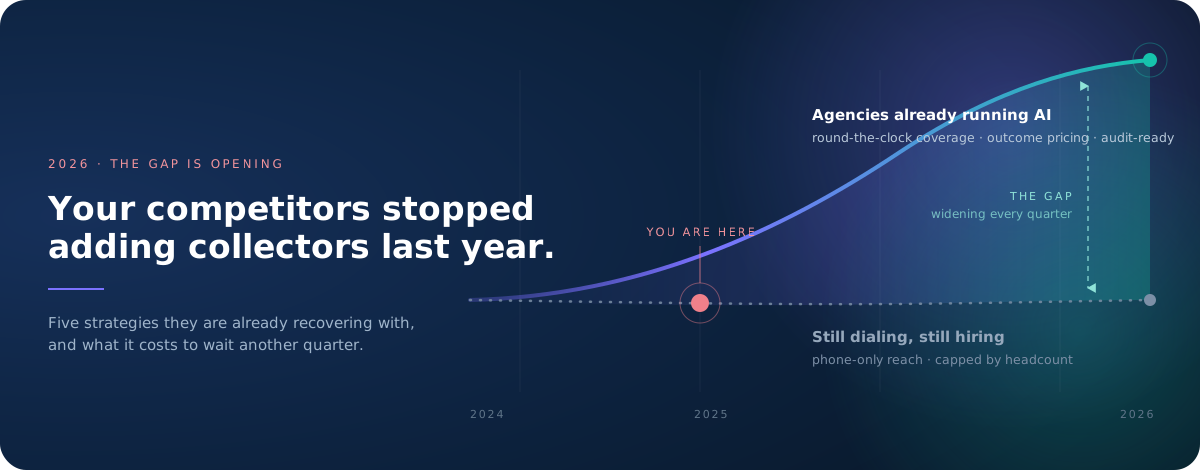 Collect Smarter, Not Harder: 5 AI Debt Collection Strategies Agencies Are Winning...